Congregation of Jesus and Mary · Since 1643
Prayer on the 19thCJM News
EN — Choose a language
← Features and Discoveries

Saint John Eudes · A legacy for the Church

Doctor
of the Church?

Sharing the richness of a life and a teaching.

A feature on the cause for recognizing Saint John Eudes as a Doctor of the Church: its inspiration, history, and the people who carried it forward.

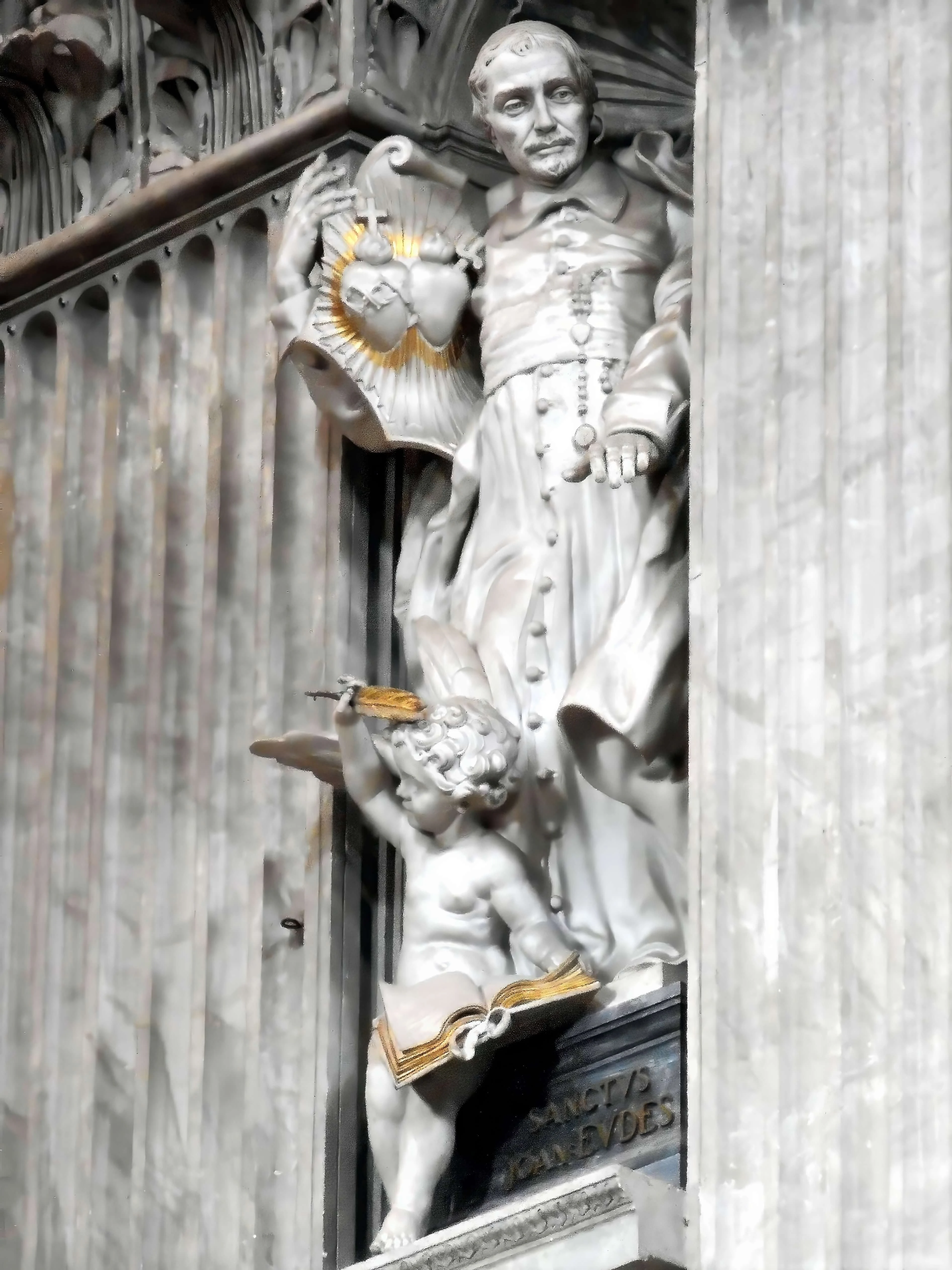
Statue of Saint John Eudes holding the Hearts of Jesus and MaryJohn Eudes · 1601–1680

Editorial

A spiritual treasure
to share

The Congregation of Jesus and Mary and the Congregation of Our Lady of Charity of the Good Shepherd, aware that they had received a spiritual treasure for the whole Church, presented the cause for their founder, Saint John Eudes (1601–1680), to be recognized as a Doctor of the Church. His teaching is contained in the 13 volumes of his Complete Works.

We believe the way Saint John Eudes developed to accompany Christian experience can offer important support for believers’ lives and for proclaiming the Gospel of Christ in today’s world. John Eudes lived at the dawn of modernity, when people’s understanding of reality and their place in it was changing profoundly. The seventeenth century saw innumerable upheavals: Copernicus and Descartes and the birth of modern science; Western exploration of every continent; and missionary expansion to Canada and Cochinchina. It was also a time of a decisive turn inward, a movement toward the heart as the essential place of being, where the search for truth now unfolded. In this context, Saint John Eudes and many of his contemporaries sought ways to express and accompany Christian experience. Bérulle, Olier, Vincent de Paul, and many other holy figures helped bring about a new evangelization. At the beginning of the twentieth century, Abbé Bremond named this spiritual and apostolic renewal the French School of Spirituality, whose influence remains lasting and fruitful throughout the universal Church.

We would like his teaching to be presented more widely to the faithful today. We want to share our heritage so that the whole Church may benefit from the inspiration that shaped our founder’s life, ministry, and works. May the process of recognition reach its conclusion, for the greater glory of God and the good of the Church.

Jean-Michel Amouriaux, Editorial from the original feature

The Cause for Recognition

Why should Saint John Eudes be declared
a Doctor of the Church?

Throughout history, the Church has offered the faithful the witness of women and men who can guide them in following Christ, understanding the faith, and living as Christians. Over the centuries, the Church has given the title “Doctor of the Church” to great saints whose lives and teaching enrich and guide all the baptized. In recent decades, the title has been granted to figures as diverse as Saint Catherine of Siena, Saint Thérèse of Lisieux, Saint John of Ávila, and Saint Hildegard of Bingen.

In this spirit, the Eudists, the Sisters of Our Lady of Charity, the Sisters of the Good Shepherd, and the women’s congregations that inherit the legacy of Saint John Eudes are asking the Bishops’ Conference of France to support the cause for his recognition as a Doctor of the Church.

After extensive consultations across the Church and in different countries, the Eudists, together with congregations of the same spiritual family and perhaps dioceses in France, wish to submit the cause for recognition of Saint John Eudes as a Doctor of the Church to the Church’s discernment. Through his missionary experience, preaching, and commitment to priestly formation, John Eudes helped renew Christian life in a difficult time of rupture and change. In particular, through the powerful image of the Heart, he opened a concrete spiritual path on which every baptized person is invited, following Mary, to “form Jesus within.” The life, witness, writings, and legacy of Saint John Eudes—a missionary priest and teacher of Christian life—have much to contribute to new evangelization and a renewal of baptismal life in the Catholic renewal of the seventeenth century.

Beyond the merits recognized at his canonization, Saint John Eudes’s pastoral practice and teaching—helping Christ “live and reign” in every baptized person—and his eminent doctrine of the Heart, the Heart of Jesus and the Heart of Mary, support greater recognition by the Church for the good of all Christians.
Eudist Papers · 27

On the Path to Recognition

Read the feature directly on this page.

Open the PDF full screen ↗

December 3, 2016 · Historical milestone

An audience with Pope Francis

Bishop Luc Crépy, then Bishop of Le Puy-en-Velay, met with Pope Francis to discuss the possibility of recognizing Saint John Eudes as a Doctor of the Church. He was accompanied by Father Camilo Bernal, then Superior General of the Eudists, and Sister Marie-Françoise Le Brizaut.

The meeting focused on John Eudes’s influence and the contribution his spirituality and teaching could make to the whole Church.

A witness to mercy

Faith expressed through service

For John Eudes, contemplation of the Hearts of Jesus and Mary inspired a practical concern for people. His service to the sick, missions in rural areas, and commitment to forming priests all expressed the same desire: to make God’s love known.

In Bishop Michel Dubost’s portrait, mercy connects John Eudes’s prayer, preaching, and foundations.

Read Bishop Michel Dubost’s portrait ↗

From formation to influence

A life, foundations,
and a legacy

Milestone 01

Formation

John Eudes was born on November 14, 1601—the same year as Louis XIII—in Ri, near Argentan in Normandy. After completing his humanities studies at the Jesuit college in Caen, he joined the recently founded French Oratory of Jesus on Rue Saint-Honoré in Paris on March 23, 1623. Its founder, Cardinal Pierre de Bérulle, welcomed him. Ordained a priest on December 20, he celebrated his first Mass on Christmas Day, then continued his theological studies in the Oratory community at Aubervilliers.

Milestone 02

Foundation of the Congregation of Jesus and Mary

Returning to Normandy in 1627, he was first sent to the area around Vrigny in the Diocese of Sées, which was suffering from the plague. He survived the epidemic and saw the material and spiritual neglect in which rural communities lived. He drew an apostolic priority from this experience: if society was to be renewed as Christian, priests had to be formed to serve rural parishes and preach popular missions. In keeping with the Council of Trent’s directives on clerical formation, on March 19, 1643, he left the Oratory community in Caen, where he was superior, to open a seminary in the city. He gathered seven experienced priests and missionaries capable of becoming formators, and on March 25, with the approval of the Bishop of Bayeux, founded a society of priests dedicated both to forming seminarians and clergy and to preaching parish missions: the Congregation of Jesus and Mary, known as the Eudists. During his lifetime, Eudist seminaries spread from Caen to Coutances, Lisieux, Rouen, Évreux, and Rennes.

Milestone 03

Foundation of the Order of Our Lady of Charity

As early as 1634, John Eudes considered establishing a “refuge” in Caen for “fallen women”—women wishing to leave a life of promiscuity or prostitution. In 1641, with help from members of the Company of the Blessed Sacrament, he established Our Lady of Refuge. Some time later, he entrusted this work to religious sisters and, with help from the Visitandines of Caen, founded an institute that became the Order of Our Lady of Charity. Bishop Molé of Bayeux recognized the order on February 8, 1651; it was also recognized by a papal bull of Alexander VII on January 2, 1666. During the founder’s lifetime, monasteries were established in Rennes (1673), Hennebont, and Vannes (1676), in addition to the one in Caen.

Milestone 04

Preaching

By the time of his death in Caen on August 19, 1680, John Eudes had preached 110 missions between 1632 and 1676, including 90 in Normandy, mainly in the Diocese of Coutances. These popular missions aimed to rekindle faith and Catholic fervor in the parishes. Each lasted about six weeks. Mornings were devoted to preaching and afternoons to catechism or conferences. The missionary also heard the people’s confessions.

John Eudes also preached before the queen mother, Anne of Austria, who held him in high regard. Louis XIV, after supporting the foundation of the Congregation of Jesus and Mary, came to suspect the saint of opposing his Gallican policies between 1674 and 1679. John Eudes’s liturgical and literary work promoting devotion to the Hearts of Jesus and Mary should also be noted. In 1648, during a mission in Autun, he had the Mass and Office of the Heart of Mary celebrated with the bishop’s approval; he had composed their structure. In 1672, he did the same for the Mass and Office of the Heart of Jesus in Caen and four other seminaries.

Milestone 05

Veneration

After his death, John Eudes was buried in the Church of the Most Holy Hearts of Jesus and Mary at the Eudist seminary in Caen. In 1810, his remains were transferred to Notre-Dame-de-la-Gloriette. Since March 6, 1884, they have rested in the crypt beneath the south transept of this former Jesuit church.

John Eudes was beatified by Pius X in 1909 and canonized by Pius XI in 1925. His feast day is celebrated on August 19.

On November 8, 2014, during the plenary assembly of the Bishops’ Conference of France, Bishop Michel Dubost announced the conference’s support for the cause of Saint John Eudes as a Doctor of the Church. In December 2016, Bishop Luc Crépy, Bishop of Le Puy-en-Velay, met Pope Francis in a private audience to support the cause.

The written heritage

Preserved manuscripts

  1. The statutes and constitutions of the Congregation of Jesus and Mary; quarto, about 600 pages. (This work was printed in 1875, with changes considered necessary by the General Assemblies or required by the Sacred Congregation of Bishops and Regulars, which approved it on June 18, 1874.)
  2. The directory with explanations for the Divine Office and other ceremonies of the Monasteries of Our Lady of Charity, following the practice of the Visitation Sisters; a 100-page quarto booklet. (This manuscript was used to prepare the Customs and Ceremonial of Our Lady of Charity, printed in Caen, first in octavo in 1682 and then in square quarto in 1728.)
  3. Memoriale Beneficiorum Dei, or the principal favors I have received from God through his Son, Our Lord Jesus Christ, and through his most holy Mother; quarto, 50 pages.
  4. Various short works: The testament of the Venerable Father Eudes; the vow or offerings to Jesus as a victim; the covenant with the Blessed Virgin; a letter to the Blessed Virgin; vows of obedience and stability; a vow of chastity for a layperson; a vow of martyrdom; and others.
  5. Letters or fragments of letters, numbering 156.
  6. Letters: Ten previously unpublished letters published in 1958 in C. Berthelot du Chesnay, Saint John Eudes: Selected Texts (Namur: Éditions du Soleil Levant, 1958). Seven of these letters are addressed to Mother Mechtilde (Catherine de Bar).
  7. The admirable life of Marie des Vallées and the extraordinary events in her life, one quarto volume. The incomplete copy was found in the library of Université Laval in Quebec and published in 2013 (Volume XIII). Strictly speaking, this is not a book by Saint John Eudes, but a collection of notes he wrote at the devout woman’s dictation and arranged for the Bishop of Coutances, who had entrusted her spiritual care to him. He never intended to publish this text; it was copied, probably inaccurately, by a disloyal secretary. 

People featured in the historical dossier

Postulators of the cause

Mgr Luc Crépy

Bishop Luc Crépy, C.J.M.

The feature identifies him as postulator of the cause, responsible for bringing together the theological, spiritual, and pastoral materials for the Church’s discernment.

Sister Marie-Françoise Le Brizaut

Sister Marie-Françoise Le Brizaut, R.B.P.

A Sister of Our Lady of Charity of the Good Shepherd, she served as vice-postulator and worked with Bishop Luc Crépy. She died on March 28, 2019.